Refinance Appraisal Came In Low: What It Does to Your BRRRR Cash Out
Your refinance appraisal came in low, so the loan shrinks 75 cents per dollar missed. See what it costs on a $500,000 BRRRR and how to fight the number.
By the BRRRRCalculator.org team
When your refinance appraisal came in low, the lender sizes the new loan on that lower value, not on the after-repair value in your model. At a 75% cap, every $1,000 the appraisal misses costs you $750 of cash back, and the gap stays in the house as equity you cannot spend.
The deal did not get worse. The loan got smaller.
Five things you can do about it:
- Read the report and look for factual errors
- Ask the lender for a reconsideration of value, with sales attached
- Close the smaller loan and leave the gap in
- Move to a new lender and pay for a second appraisal
- Hold, finish leasing, and come back later
Most of this runs through the lender rather than the appraiser, so it helps to know the seasoning and loan-to-value rules behind a cash-out refinance before you argue about a number.
How a low appraisal shrinks the loan and the cash you get back
The standard deal on this site buys at $300,000, spends $60,000 on rehab, and finishes at a $500,000 value. All in at $360,000. A cash-out refinance at 75% of $500,000 lends $375,000, which returns the full $360,000 plus $15,000.
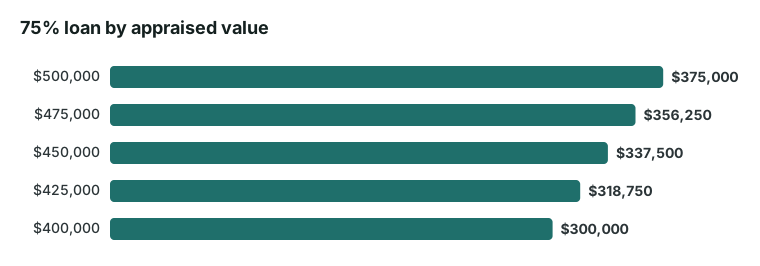
That 75% is a loan-to-value cap, and it applies to the appraised value. Your own estimate has no standing in the file.
| Appraised value | 75% loan | Cash left in the deal |
|---|---|---|
| $500,000 | $375,000 | None, $15,000 back |
| $475,000 | $356,250 | $3,750 |
| $450,000 | $337,500 | $22,500 |
| $425,000 | $318,750 | $41,250 |
| $400,000 | $300,000 | $60,000 |
Those figures are before closing costs. Lender fees, title and the appraisal itself usually run 2% to 3% of the loan, so $7,500 to $11,250 on a $375,000 loan, which comes off the wire.
A $450,000 appraisal, 10% under plan, is the common case. It is not a disaster. It is $22,500 of your money parked in a house for a few years.
Why appraisals come in under ARV on a rehabbed rental
Four reasons cover most misses.
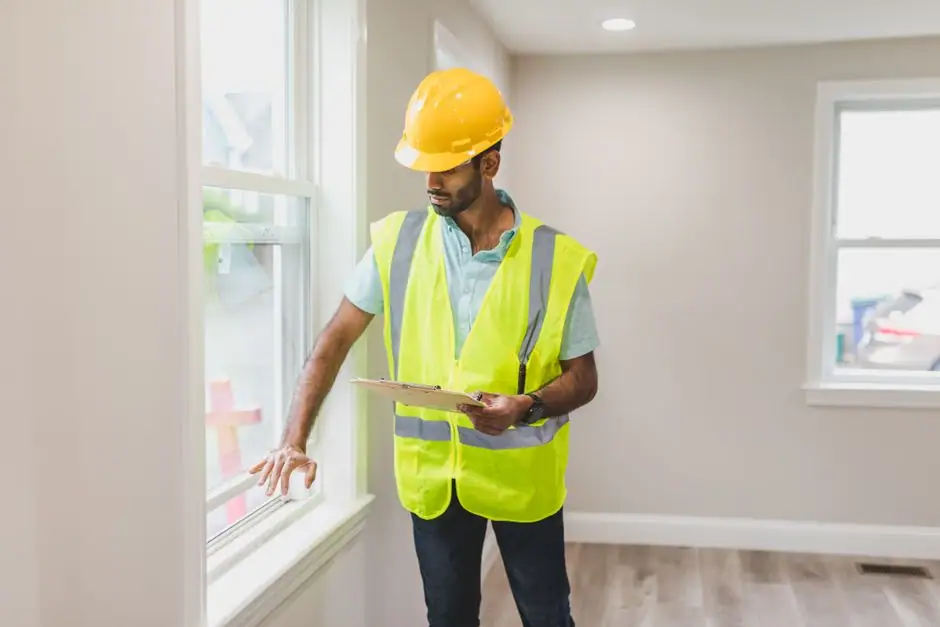
The sales are not there. Appraisers lean on the sales comparison approach, meaning recent closed sales of similar nearby houses. If nothing renovated in that pocket has sold near $500,000, nobody can defend $500,000.
The sales used were stale or mismatched. Six-month-old closings in a rising market, or a smaller house two neighborhoods over, both drag the number down.
Your rehab is invisible in the data. New mechanicals, a new roof and a new kitchen do not change square footage. They show up only if someone writes them down.
The ceiling is real. On blocks where distressed houses trade at 85% to 90% of finished value, no renovation creates a $200,000 spread. The $450,000 ARV page shows what the same purchase and rehab look like at a lower finished value.
What to give the appraiser before the visit
Hand over a packet. Appraisers can accept information; what they cannot accept is pressure on the conclusion. Keep yours factual and the visit stays clean.
Put in it:
- A scope of work, before and after, with costs by line
- Permits and inspection sign-offs
- Before photos, taken the day you closed
- Three to five closed sales you believe support the value, with addresses, dates and prices
- The signed lease and a rent roll
- Any pending sale nearby that you know about
Meet them at the house and spend fifteen minutes walking the work. Point at the panel, the roof line, the subfloor. The valuation still follows standard real estate appraisal method, and the comparison approach carries residential work, but condition ratings come from what the appraiser sees and verifies.
Asking for a reconsideration of value, and what evidence works
A reconsideration of value, often shortened to ROV, is a written request asking the lender to have the appraiser review specific evidence and revisit the number. You send it to the lender, not to the appraiser.
What works: closed sales the report missed, with full details on each. A factual error, such as wrong square footage, wrong bedroom count or a wrong condition rating. A sale used as a comp that closed in unrenovated condition.
What does not work: your opinion, your budget, the rate you need, or the cash you wanted back. Cost is not value.
Conventional files follow the agency rules, and the Fannie Mae Selling Guide spells out how lenders handle appraisals and borrower-supplied data. Many lenders allow one round and will not reorder an appraisal because you disagree with it.
Is a second appraisal with a new lender worth the cost?
An appraisal belongs to the lender who ordered it, so a new lender orders a new one. That is another fee, another underwrite, and another thirty to forty-five days of holding costs at $850 a month in the standard deal.
It is worth it when the first report used clearly wrong sales or came from someone who does not work that submarket. It is not worth it when the sales genuinely are not there. Two appraisers reading the same thin market will often agree.
Seasoning works in your favor here. Once you are past the six-month mark, waiting another quarter costs you payments but can add fresh comps.
What to do with a deal that only half refinances
Take the smaller loan and move on. At $450,000 you leave $22,500 in, and the lighter payment makes the property easier to qualify and easier to hold. The way lenders size a DSCR refinance actually rewards the lower loan, since coverage improves when the payment drops.
Or switch products. If the smaller loan still clears your existing payoff, a rate and term refinance instead of a cash-out often prices better and caps higher, which gets you out of hard money even if no cash comes back.
Or sell. If the appraisal says the market is $450,000 and you are all in at $360,000, a sale pays you the spread minus selling costs and frees the capital for the next one.
What you should not do is keep the money trapped and call the deal finished. Decide which exit you are taking.
Run the numbers before the appraiser shows up
Model the refinance 5% and 10% under your target value, then see which outcome you can live with. The BRRRR Calculator on the home page shows the loan, the cash back and the cash left in at any appraised value, so a low appraisal becomes a number you planned for instead of a surprise at closing.
Frequently asked questions
Can a low appraisal stop a refinance from closing?
Rarely. The loan still closes, it just closes smaller. A lower value lends less, so you get less cash back and leave more of your own money in the house. It only kills the deal when the new loan cannot pay off your existing financing, and then you either bring the shortfall to closing or you do not close.
Who pays for the appraisal on a cash-out refinance?
You do, as the borrower. The lender orders it to protect its own position, but the fee lands on you, usually collected up front or at closing. Budget roughly $500 to $800 for a single-family investment property, more for two to four units or a rural address. The fee is not refundable if the value disappoints.
Does a low appraisal hurt my debt service coverage ratio?
No, it usually helps. A smaller loan means a smaller payment, so the rent covers it more easily. In the standard deal, $4,400 of rent against a $375,000 loan gives coverage near 1.35, and against a $337,500 loan it rises to roughly 1.45. A low appraisal costs you cash back rather than approval.
How long should I wait before trying another appraisal?
Long enough for something to change. A second appraisal ordered days after the first, drawing on the same sales, tends to land in the same place. Waiting one or two quarters lets new renovated sales close nearby and lets your lease season. Weigh that against the $850 a month of holding costs in the standard example.
Does the appraiser know what I paid for the house?
Yes. The purchase price and date sit in public record and in the lender's file, and the report will note both. That is why your paperwork matters. A gap between a $300,000 purchase and a $500,000 value looks like a stretch on its own, and looks ordinary next to a $60,000 scope of work with permits and receipts.